
How this was made
A website that does what the app does.
Notes on designing and building the October 2026 Drip site, by Arian Shamsabadi.
- Rounds
- 5
- Languages
- 2
- Phone screens rebuilt
- 4
- Hero scroll, lab test
- ~77 fps
Too many clothes, nothing to wear.
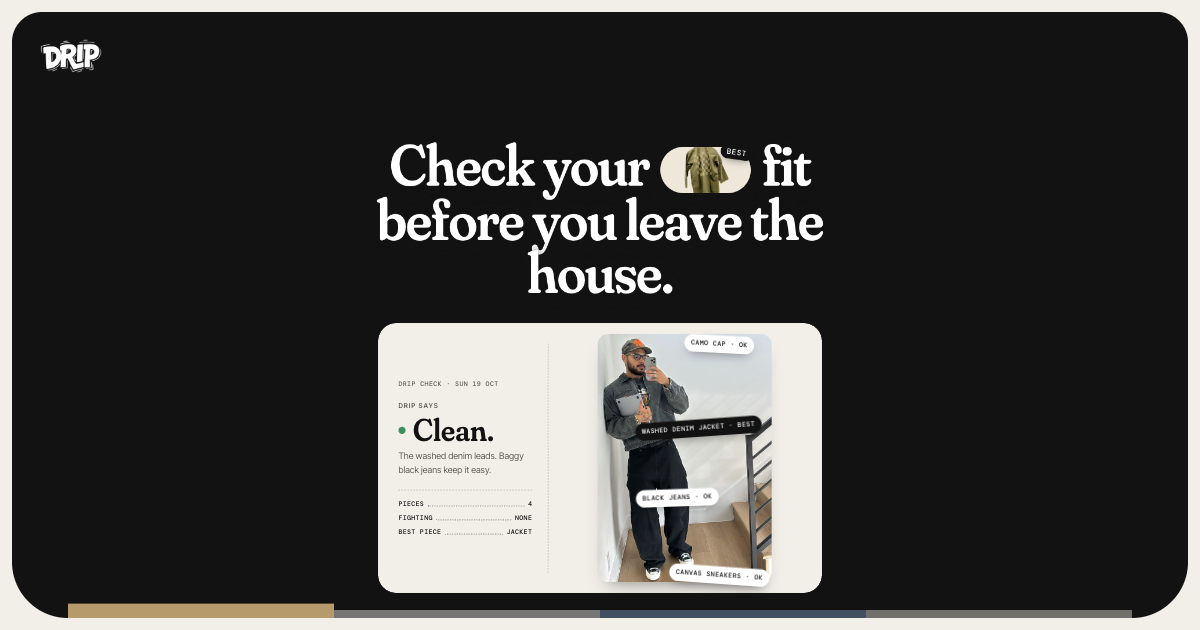
The site acts out what the app does. The hero opens on a mess of floating clothes, and scrolling is Drip sorting it: everything you don’t need slips away, and one outfit check develops on paper, tagged piece by piece with a one-word verdict.
Everything after that follows the same rule: show the moment, don’t describe it. Updates print as receipts, the waitlist prints a receipt as you fill it in, and the questions are the small print.
The phones are the app, not screenshots.
Each phone in How it works is rebuilt in HTML from the app’s own October screens: the paper-print camera, the Getting ready band, the verdict with its hang tags, and Days, all sitting on the N2 dock.
Inside a screen, one unit is one point of a 393-point iPhone at a tenth of its size, so every phone stays sharp and in proportion at any width.
Five rounds on a design canvas.
It started from the app’s design language, went immersive and phone-first, became a website, tried three looks, and ended as this showcase.
The rules came from review notes along the way: real people in everyday outfits, no repeated photos, nothing that reads as a template, receipts that look like paper, and app screens that match the app exactly.
Smooth on a phone, still without motion.
Scrolling never re-renders the page. Each frame writes a few progress values to the hero, and every moving piece reads them in CSS, so only transforms and opacity change and the browser’s compositor does the work.
In a lab test on a production build (headless Chrome, with the CPU slowed four times to stand in for a phone), the hero scrolled at about 77 frames a second with no layout work during the scroll. With Reduce Motion on, nothing floats or sways: the finished outfit check is simply there.
The app’s system, carried to the web.
Fraunces for headlines, Inter Tight for text, DM Mono for receipts and labels, and Archivo for the verdict word, exactly as the app sets it. Paper and ink come from the app’s tokens, and the plan colours from its Getting ready band.
Every page also exists in Persian, right to left, set in Vazirmatn and written for Persian readers rather than translated line by line.